
A Closer Look
Ambreen Butt's "I Bear Witness" at Gallery Wendi Norris

Ambreen Butt is chronically online — but you wouldn’t know it by looking at her artwork. The Pakistani American artist’s latest solo show, “I Bear Witness,” at Gallery Wendi Norris in San Francisco, responds to the constant trauma of being inundated with images of violence in the social media age, offering viewers the opportunity to reflect and consider their response. It’s also a bold statement from a commercial gallery in a time of timid exhibition curation.
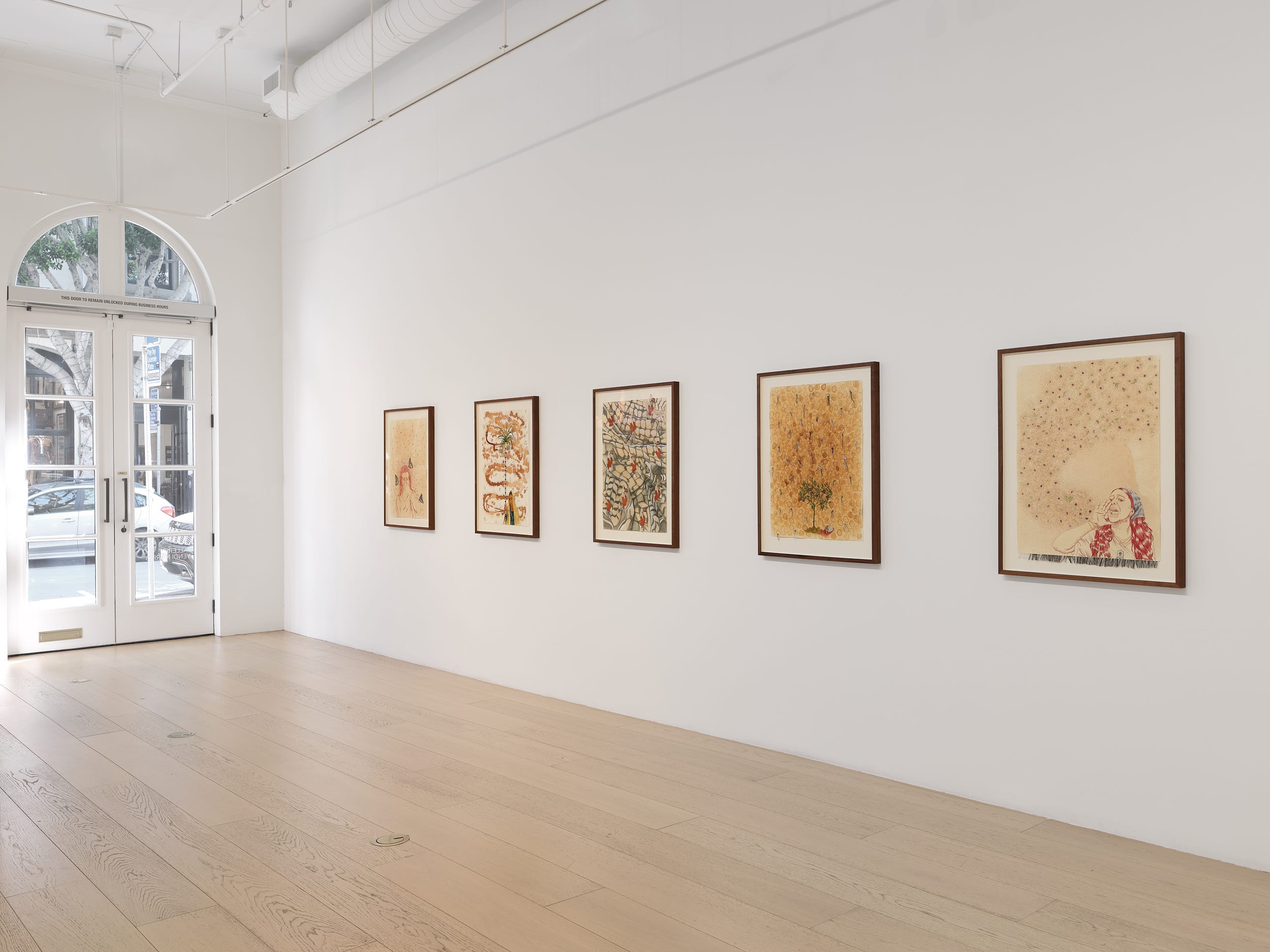
Butt’s latest body of work, all pieces dated 2026, is the conclusion of a trilogy of exhibitions a decade in the making: the first, “Say My Name,” in 2020, collected the names and ages of the victims of US drone strikes during the war on terror. “Lay Bare My Arms,” in 2023, explored gun culture. The most recent series retroactively addresses the themes of the previous two as well as the current media landscape, asking what it means to bear witness to the horrors of genocide, war and terrorism as they are livestreamed almost in real time for public consumption.
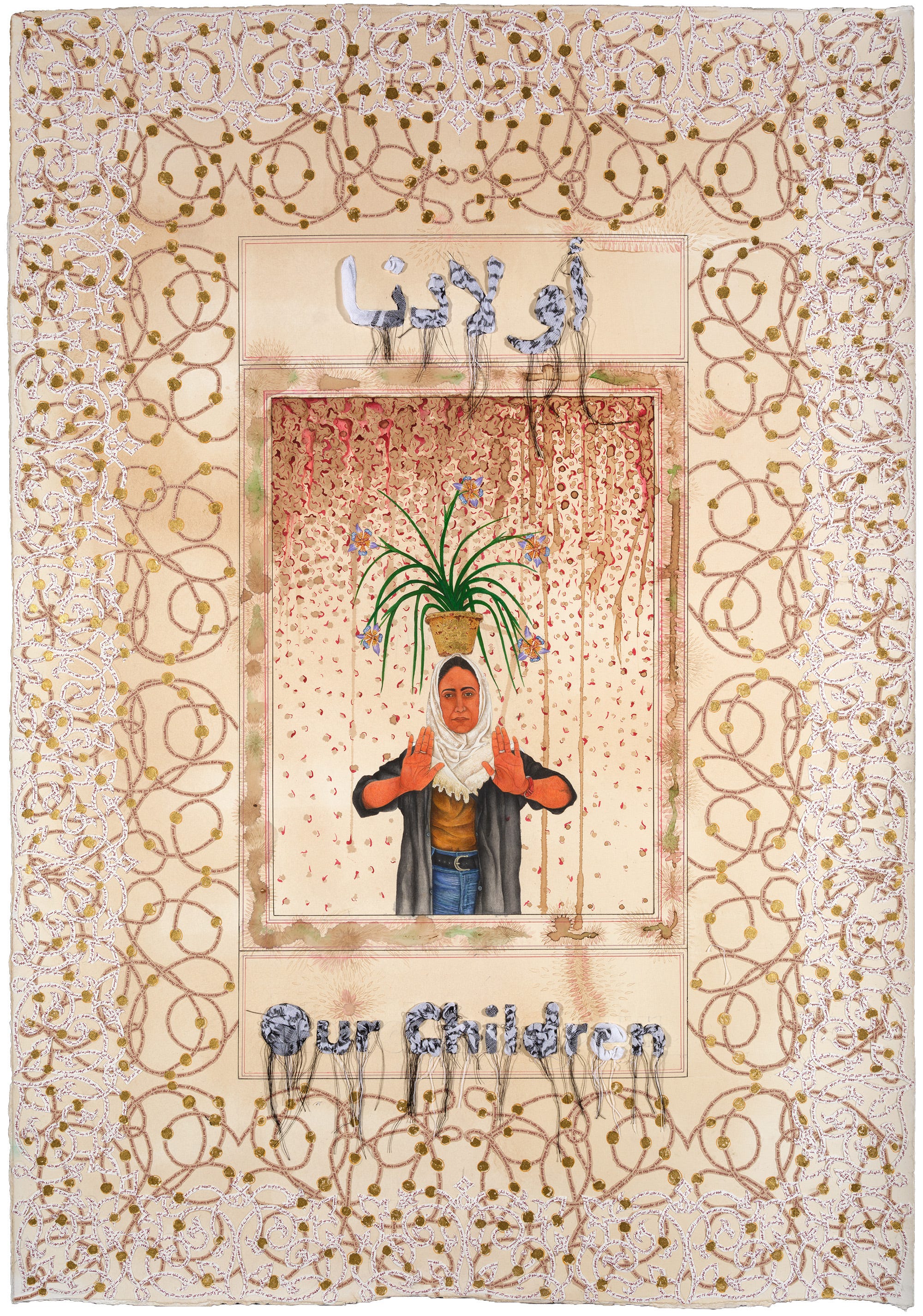
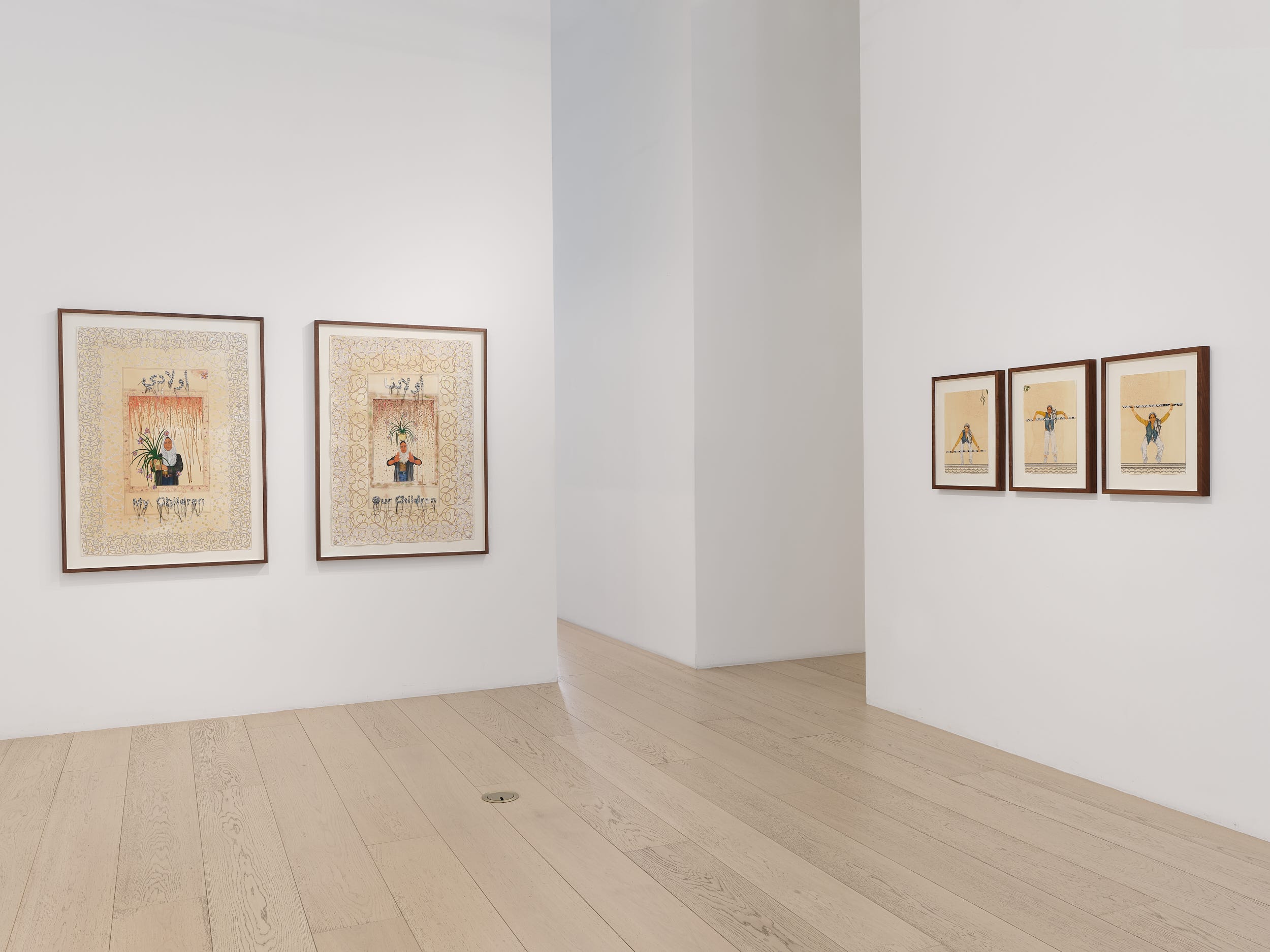
Both pieces in the diptych “Awladi (My Children)” and “Awladna (Our Children)” feature a woman wearing a headscarf and holding a potted plant in her arms and balanced on her head. The plant, which recurs throughout several pieces in “I Bear Witness” is a “walking iris,” a flower that blooms for just half a day and propagates itself via offshoots. In each piece, the title has been woven into the surface with keffiyeh fabric. The female subjects stand in the center of decorative borders, reminiscent of illuminated manuscripts, laced with gold leaf and collaged, printed text. In Awladi (My Children),” the titular text references an online video Butt watched of parents crying out for their children in the aftermath of missile strikes. “Awladna (Our Children)” has been collaged with the text of the 1980 poem, “Lullaby For A Palestinian Child,” by the Pakistani poet Faiz Ahmad Faiz. Applied today, the half-century old poem offers a symbol of the endurance of bearing witness and of artistic modes of protest.
The works in “I Bear Witness” don’t translate the frantic, schizoid experience of social media’s incoherence. In contrast to the bombardment of digital images, Butt’s paintings are rigorously analog. Butt works in a mix of media, including watercolor and gouache paints, natural plant-based pigments and dyes, thread, gold leaf, and keffiyeh. The density of materials, textures, and text is antithetical to viewing Butt’s work at a passing glance. One is forced to linger, to consider the larger implications and consequences. Here, social media videos of dead children and grieving grandparents morph into something meditative, positing slowness as an antidote to the rapidity of the social media news cycle. Each piece creates time and space for reflection that is often overlooked or impossible when images of violence are delivered with the speed of social media.
The difficulty metabolizing violent imagery is one that will be familiar to most readers: You open Instagram and within a few minutes of scrolling, you’ve been bombarded by snuff footage from war zones interspersed within a slew of pictures from your cousin’s wedding and AI cat videos. It’s a schizophrenic visual experience, triggering a torrent of emotions that are often difficult to parse or respond to sanely. And then there’s another kind of post that crops up and only deepens one’s sense of helplessness — the call to action. So you donate, you repost, you wonder if it did any good, and you move on to the next cat video. Butt answers the call to action with art, giving viewers the chance to deepen their own responses.
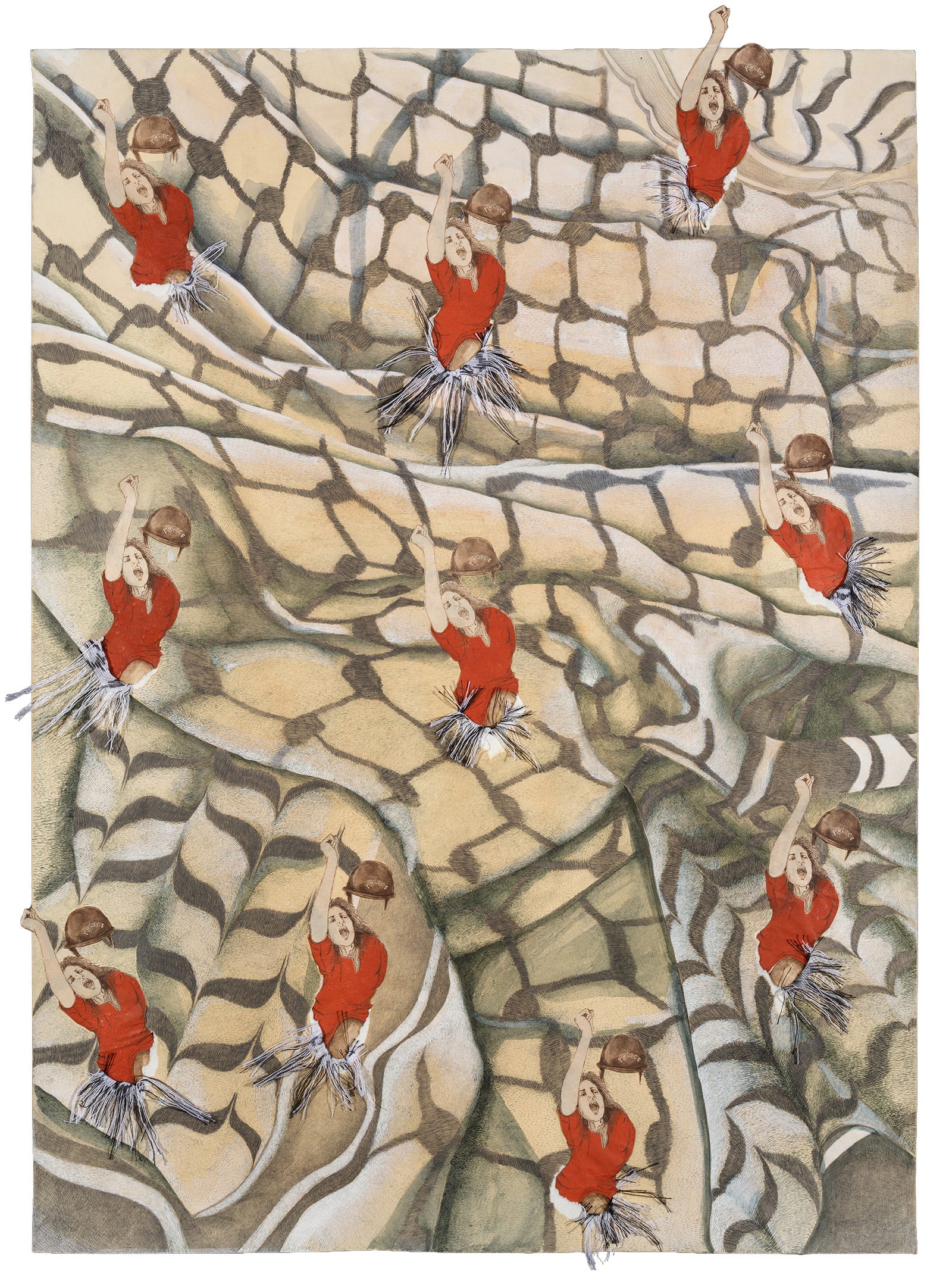
In “Rupture,” we get a familiar character of social media protest culture. The repeated collaged character of a woman raising her fist smashes through the surface of the artwork, which has been illustrated in pencil with the pattern of a keffiyeh. The figure is based on an image taken from a 1980s women’s march in Pakistan — not a contemporary image — though it could be any number of protestors spotted at recent No Kings or anti-ICE rallies. It’s a hopeful reminder that, like the seeming perennialism of the oppressive conditions that birth them, protest movements are undying. But they don’t always make their way into contemporary art spaces.
Too many museums and commercial galleries have taken a milquetoast approach in response to the current political moment, ranging from silence to outright censorship. Bay Area artists have experienced their own share of institutional censorship when speaking publicly from a pro-Palestinian position. But all art is political and the choice to exhibit seemingly apolitical, decorative, or tone-deaf art is a political choice, too. As shapers of culture, art institutions have a responsibility to present art that records and contends with contemporary life, as a matter of negotiating the present and preserving a record of history for posterity. It’s refreshing to see a commercial gallery take a vocal position.
In the related pieces “Speak!” and “Silence!” figures illustrated with red thread stitched into the surface of tea-stained paper offer two counterintuitive moments from scenes of protest. The figure in “Speak!” covers their mouth with a hand, a look of sorrow and frustration in their eyes, at the breaking point of their silence, poised to make themselves heard. Butterflies dance around the figure’s head, signaling the imminent metamorphosis. In “Silence!” a woman wearing a keffiyeh headscarf shouts, a hand cupped to her mouth and a stream of marigolds issuing from her lips, perhaps on the verge of being forcibly silenced. In “Speak!” and “Silence!,” the resonance of both censorship and assertion ring loud, their inverse impacts made tangible. It’s an apt reminder that our choice to speak up matters, too, even if it often feels ineffective and catatonia is the more familiar response.
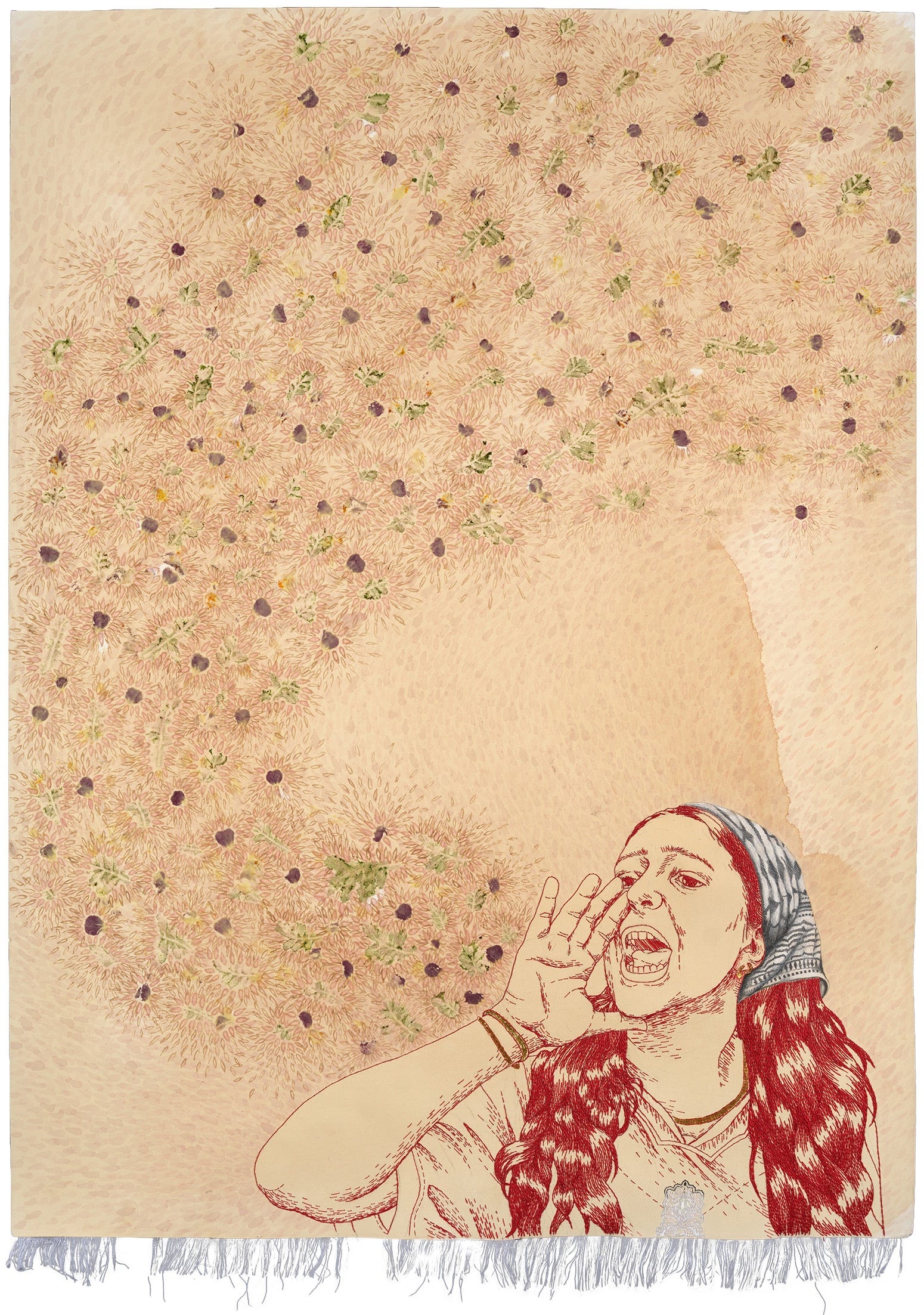
“To witness without the power to intervene is an act of endurance,” Butt says in the exhibition’s press release, “this endurance in itself is a form of resistance.”
Witnessing without the power to act describes the circumstance we’re all victims of as citizens of the Internet. But desensitization oughtn’t be confused for endurance. The strength of Butt’s work is not in passivity, but in showing how the act of witnessing can become an interrogation and negotiation of our collective circumstances and those beyond our reach. It might not constitute an intervention, but it is an inspiration and invocation — one that is impossible to ignore.
Ambreen Butt “I Bear Witness” is on view at Gallery Wendi Norris through May 9, 436 Jackson Street, San Francisco, California. This review was commissioned via Artlance.
