
Get Real!
Why I won't have another conversation about AI and you shouldn't either

I think the prospect of an interesting conversation about AI is an oxymoron. In recent months, more and more museums, galleries and other arts professionals I’ve encountered have wanted to engage, seemingly in good faith, in conversations about the legitimacy of AI, whether they think that they have something interesting to say or are just rubbernecking the train wreck that is contemporary culture. Those conversation are not worth having.
And it seems like I’m not alone in feeling this way, because last week at least two graduating college cohorts booed commencement speakers glazing AI. Maybe the kids are all right. But some of these boomers are cooked. (Also, this essay is very good.)
First of all, I am not a luddite. And AI is not like the printing press. Everyone wants to tell me how AI is just like the printing press. This is the popular defense of the subject and the reasoning for why conversations about the effects of AI might be relevant to the arts. But AI is absolutely not like the printing press. The printing press revolutionized a specific, physical technology. It created infrastructure and consolidated capital around the production of physical objects resulting from the tangible creative efforts of real human beings. AI does not do this. If you think that this is what AI does you’re part of a league of morons.
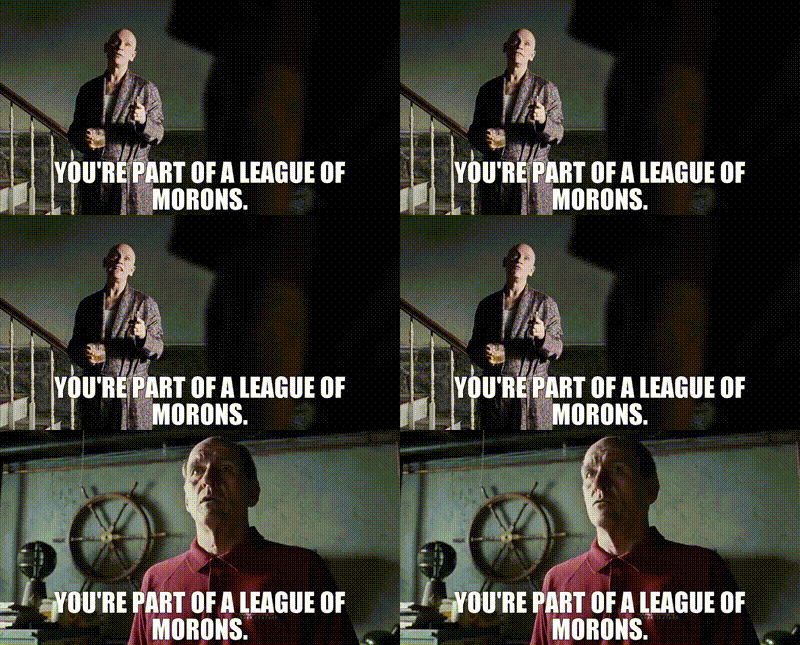
I’m sorry. This is obviously why I can’t have conversations about AI anymore. I will turn mean and nasty. But I think the way out of this cultural circle of hell we’ve found ourselves in requires some degree of harshness. From now on, I will be engaging in these conversations in bad faith. Because you are, too. This whole discourse is so unserious.
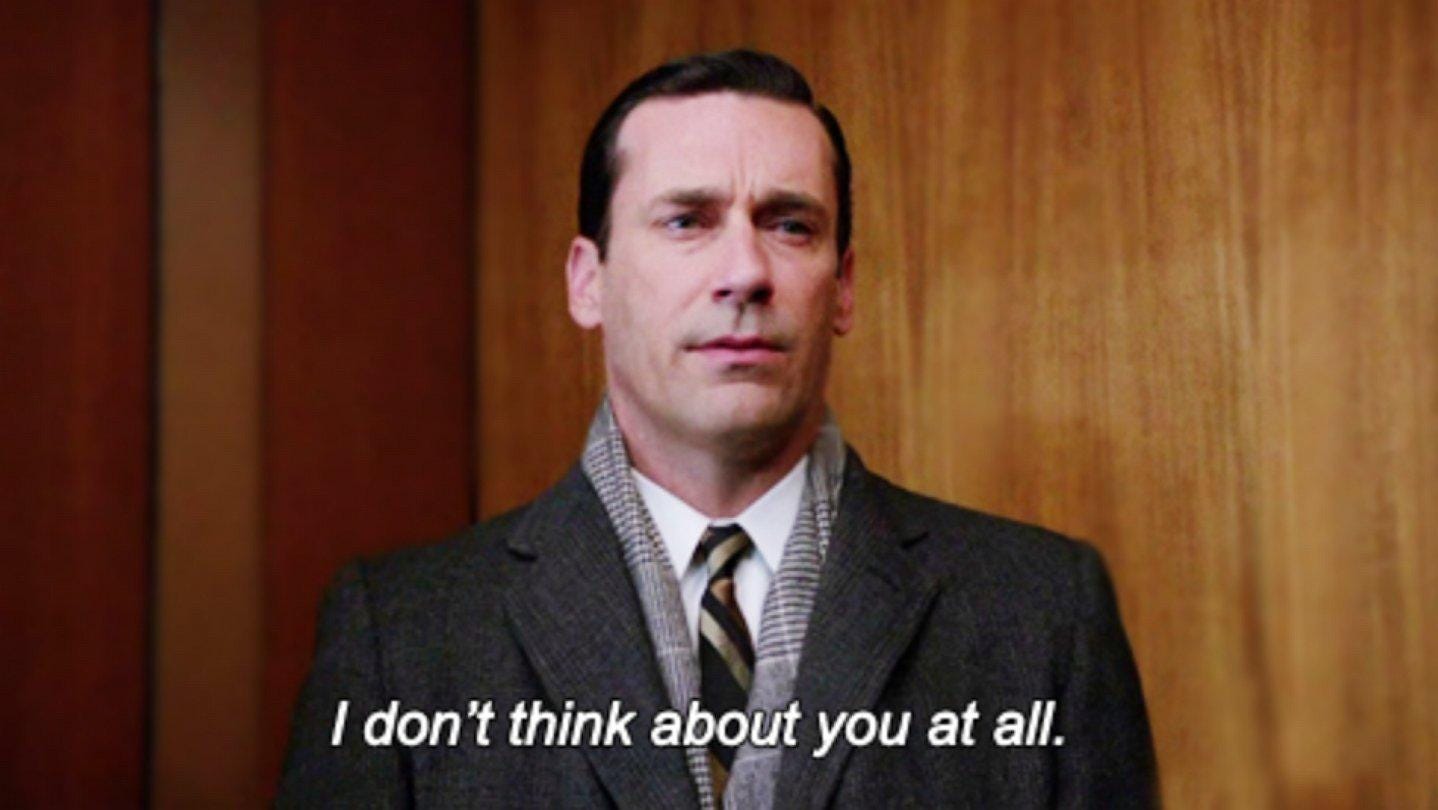
Entertaining AI, even as a risqué, silly topic of speculative conversation, lends it underserved credence. “But you have to admit it’s an interesting conversation,” the last person I tried to disagree with countered. My position is more like the “I don’t think about you at all” meme. The premise of these conversations is flawed and I am just not interested. And honestly, you shouldn’t be either. So, I won’t spend the rest of this essay discussing it. Instead, I will discuss the alternative that I stand staunchly in support of — reality.
I’m a Romanticist. I need you to know that I know that about myself and that that is where I’m coming from. That’s my orientation toward the world and art and technology. So you will not catch me out by being like, “Max you don’t have a well-rounded perspective.” That’s absolutely correct — I do not. I am biased and now I am angry. I am angry and biased and those are the table stakes. Just so we’re clear.
I believe in real shit. No fake shit. There is a reason that I have spent my life looking at paintings, reading books, throwing myself into mosh pits, and telling other people to do the same thing — I really believe that engaging directly with art might be the most immediate conduit to accessing reality and that reality — by which I guess I really mean human connection — especially as it vanishes — is the highest premium of human experience. Art like that is the physical product of real human effort made to communicate thoughts and feelings with other human beings. I got sober a decade ago, in part, because I didn’t like the idea that substance abuse was preventing me from having full, authentic experiences. This is your life.
A friend of mine recently pondered that the digital slop era might be a sort of cultural feedback loop. But I don’t think we’re stuck on a hamster wheel — I think things are moving forward, just in the wrong direction. Getting dumber faster or something like that. Maybe there is no way out of the simulacrum. But there’s a way to, at least, not participate in the most obvious grifts of our quarter-century.
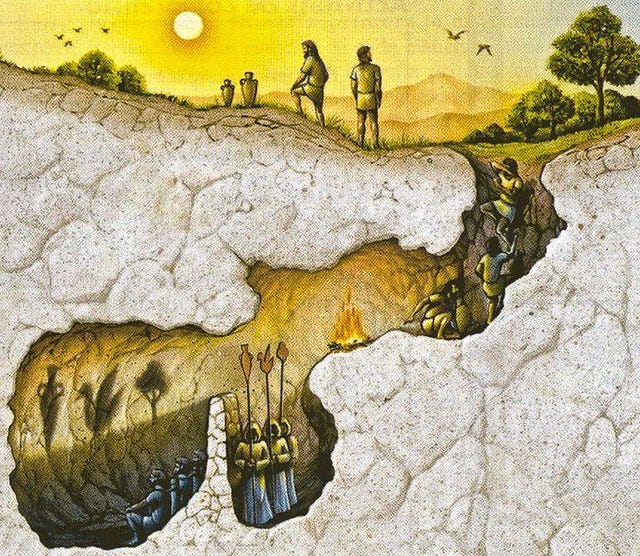
I think now is the time for radical regression. I’m not the first person to say this. Critics and theorists have been calling for the return to Modernism for a while now. Like, pre-9/11 (does such a time exist?!) Here, you can do your homework. But no more philosophizing. We need to feel our way on this one. Us Romanticists need to take a hard-line stance. Reality is too precious a thing to risk or squander. It’s worth fighting for. And maybe that fight is actually getting easier.
In a way, I am glad that we are now at a point where just the act of writing a novel, or painting a painting or playing a guitar is radical again, simply by the virtue of being real. The contents of the artworks produced by those mediums almost doesn’t matter. Now that the vernacular has become so degraded, the medium is the message again. It’s easier than ever to be an avant-gardist. Just do something outside of the digital world. I promise you, it’s not that hard.
I say the contents of those artworks almost doesn’t matter, but I also think that they do, a little bit. Like, I want art that is about real life as much as it exists in real life. I can hear you saying, “But Max, real life happens on the Internet now!” Only as long as we let it. And it can only be so real. And I’m not even saying I want art that pretends cell phones and Facebook don’t exist! But I definitely do not want art that happens inside cell phones and Facebook, or uses them as accomplices in their own creation. I just think we have to be seriously careful about what we let inside our art and what we let our art inside of, too. And guess what? The same thing is true of our real lives! You wouldn’t let your life happen online, would you? Oh, wait, yes you would — that’s why we’re in this situation!
I just feel like some of you are not taking your art as seriously as your life and it shows. And I’m not even saying everyone has to take it as seriously as I (obviously) do. But, because I take it seriously, it offends me when other people don’t.
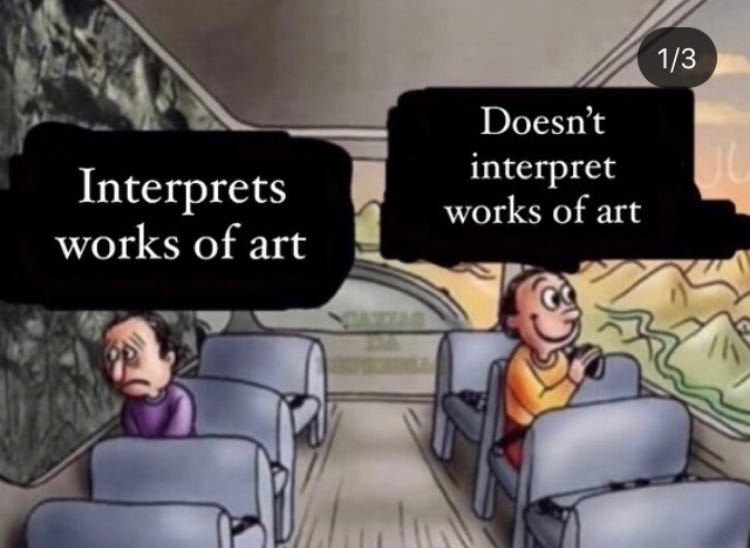
Realism and humanism can offer a counterbalance to the un-reality and anti-humanity of AI slop aesthetics and ChatGPT writing. Also, I’m afraid we have no time to waste on purely decorative art at this particular moment in time. (Abstraction has long been utilized as CIA propoganda.) Give me figurative painting. Give me sentimental prose. I want to feel something other than blasé capitulation to the modes of capital that have governed the art world for, well, maybe forever.
I also think that now is a time for didactic art. Subtlety has become the tool of the enemy. The question of veracity — of whether or not an image is real, of whether or not a piece of writing was written by a human being, whether or not what I’m seeing is fake news — is merged with the uncertainty of meaning. Earnestness and honesty feel important. Being direct feels necessary. We can’t afford ambiguity about where we stand. Some things are grey. Others are black and white. You have to be able to assess what kind of situation you’re in and respond accordingly. In a time of unstable reality, I want art that reflects real life and real life is, actually, pretty didactic, inasmuch as it is mostly made up of conversations about opinions and current events.
I encourage you to use your real, adult brain to consider, for a moment, who might benefit the most from the increasing merging of reality and unreality. I’m not going to answer for you. Because if there’s one point to this whole screed it is use your brain! But I will give you a hint: One major problem with AI is that it will materially impact the real world. It will, given enough time, destroy it. It seems to me that that is blatantly antithetical to the work artists are trying to do.
I think this essay on the didactic properties of art by David S. Wallace, in The New Yorker, has some pretty good anecdotal data about the current critical stance towards didactic art. The New York Times praised Marty Supreme because “it isn’t didactic and doesn’t serve up any life lessons” as if that’s a good thing. I guess part of the question is, what do we want from art? I, at least, want to learn something. Maybe that is one of the reasons I did not like Marty Supreme. Variety praised One Battle After Another (a film I did like) because “it’s not some in-your-face didactic absurdist thing,” which makes me wonder if the Variety reviewer even watched the movie because it was actually over the top in its didactic approach to political finger-wagging — which was one of the reasons that I liked it.
“Didactic art has a bad reputation because so often it simply falls flat,” Wallace writes, “a canned lesson in the mouth of a character has tough work to do against the uncanny surprises of reality. But maybe, then, it’s just that our idea of teaching that needs to be recalibrated.”
I mostly agree with this. But I also think plenty of canned lessons get passed around verbally in real life. In part, as a way of coping with the uncanny surprises of reality. We simplify things in order to make sense of them. Why should our art be above this? Why should we strive to create art that seemingly exists in some idealized world of indirect communication and layered symbolism? That strikes me as a dangerous desire, dangerously close to the kind of intentionally ambiguous experience passed off as artistry that is present in the slippage between reality and falsehood resulting from the use of AI.
“To open the channel of the didactic is, in part, to expect more of ourselves and of others,” Wallace writes, “to hope that we might grow together.”
Why shouldn’t we desire art that strives to teach, to communicate, to signal clearly our intentions and beliefs, not in the interest of divisiveness but in aid of coming together? We should. I think it literally might be our only hope. Maybe this is a foolish hope, but one that I find myself still holding onto. Why ask for less from each other? This is the standard I would want to be held to, at the very least. And, for as long as we are all in this same, shared reality together, we have to keep working hard to make it the best possible reality it can be. So I will be holding you to the same standard. And it starts by not having another conversation about AI.
Thank you! I am heartened by your writing and your need to see figurative work, read sentimental poetry, experience “Real” things.
Good screed ✔️