
Road Trips
May newsletter

Last month, Anna and I spent about two weeks in Paris and the UK. We spent the majority of our time in Paris, where Anna was attending a glaze chemistry workshop and I was walking around the city. I saw some great art, ate good food, and visited friends. It was a breath of fresh air to be outside America and I tried very hard not to rubberneck from a distance but be as present as possible in my shifted context.
I more or less wandered into a Leonora Carrington survey at the Musée du Luxembourg which absolutely blew me away. I also took an obligatory spin through the Musée d’Orsay which defended its title as my favorite Parisian museum. Overall, though, I didn’t overdo the art, trying my best to lean into the idea of this as a proper vacation.
In London, we did spend almost an entire day in the Victoria and Albert Museum, where Anna got to geek out on pottery and I drooled over the collection of cameras and photographs in the Photography Centre. I also visited the mecca of hardcore music that is All Ages Records in Camden, the kind of place that you hear whispers of in the annals of music history. Being there made me feel like a kid again.
We spent the last few days of our trip relaxing in the Scottish countryside an hour-ish outside Edinburgh, which I was pleasantly surprised to see how much it resembled the Northern California coast. It was nice to end the trip in peace and quiet, visiting friends who moved there a couple years ago and getting a good dose of country life.
Amidst my time off last month, I managed to write a couple of urgent articles that have not lost their urgency and would be worth your time to click on now. The first was a piece about the connections between the board members at the Djerassi Artist Residency and Jeffrey Epstein and the second was about the merger of San Francisco’s City arts agencies and how it might negatively impact the local nonprofit landscape.
I am still reading Solvej Balle’s Calculation of Volume series and loving it. The second volume is the weakest so far, in my opinion, but things really pick up in volumes three and four. These books are such a smart, wide-ranging exploration of one of art’s most tired sci-fi tropes that the execution of the form itself is a victory. And then, on top of that, the writing is good, the ideas are intriguing, the emotional landscape is deep. I look forward to enjoying the rest of the series over the next two-ish years as my life, like the lives of the characters, unfolds at the behest of Balle’s timeline.
I also read Ben Lerner’s new little novel Transcription on the flight home. Its brevity does not lend itself to digestibility and in typical Lerner fashion it takes a series of heady digressions into philosophical territory. Unfortunately, the whole thing is just sort of cringe. It reads like boomer dad screed against phone culture because, well, that’s exactly what it is. Accept Lerner is not a boomer and he is too smart for old-man-shakes-fist-at-cloud reductionism. So instead, we get boomer dad screed against phone culture in the guise of smart young guy thinking about the way technology governs culture and social interaction have made life weird. The narrator is always reaching for his phone, everyone is talking about phones and social media, both of the children in the books develop social-media informed eating disorders. It’s a realistic portrait of phone culture (which is to say culture) — I guess — but who wants that? We live it everyday and it sucks.
This problem isn’t limited to Lerner. I can’t think of a single compelling work of art about technology and its effects on contemporary society. And I think that’s because the subject just isn’t interesting. But Max, you say, any subject can be interesting in the hands of the right artist. I’m not so sure. I think that technology — specifically phones and social media — and the way that it has taken over our lives is so antithetical to art-making and art-experiencing that it is actually impossible to transmute it into art. That’s not a knock against the limitations of art — it’s an illustration of how insidious and evil technology has become. It has moved beyond any correlation to humanity. I mean, not even Ben fucking Lerner can make it interesting!
If your curiosity is piqued, I like a lot of what the novelist Brandon Taylor has to say in his review.
Returning to the USA meant also returning to the waking nightmare that is baseball fandom.
While I was traveling, I gave myself the gentle mercy of not keeping track of baseball. I glanced at the score, if I remembered, but I largely let it be a thing of another timezone. Catching up on the Giants season has not been inspiring. Since I’ve been home, the team has spiraled into full-blown collapse.
The Giants arrived in Philadelphia last week for a three game series against the Phillies who, with a record worse than the 13-15 Giants, had fired their manager, Rob Thomson, that morning. The Giants directive seemed clear. Hit ‘em while they’re down and hit ‘em hard, recouping an easy three wins and pulling ahead of .500. Instead, the Giants let themselves get swept, losing game one of the series 0-7. Baffling.
The roadtrip continued to Tampa, Florida, for another three games against the 18-12 Rays. Again, the Giants got swept, this time tantalizing fans with early leads and potential comeback innings, only to squander every opportunity, hit into routine outs and present a masterclass in some of the worst pitching decisions I’ve ever witnessed.
The Giants appear to be operating on a game plan of one bad decision to the next.
A buddy of mine went so far as to make the claim that the hiring of G’s legend Buster Posey to the position of President of Baseball Operations was a mistake. My knee-jerk reaction was to refute this. But then I sat with it and… I kind of think he’s right? Posey may be a great ball player but he’s never had this kind of job before. It’s like promoting a server to head chef, an artist to museum director, an actor to director. Just because the two jobs are adjacent does not mean that one provides all — or any — of the requisite experience for the other. And what the heck is Bruce Bochy doing in his position as Special Advisor to Baseball Operations? I can’t imagine he’s doing anything, other than collecting a golden parachute and appeasing the fanbase with his spectral presence.
So, the Giants return home to San Francisco 13-21 — one game behind the Rockies, for crying out loud — to face the 20-13 San Diego Padres who are one game behind the Dodgers in a three game series that starts tonight.
My hope-o-meter has ticked past zero. And it’s a real shame, because baseball is one of the precious few things I rely on to keep me sane during the downward spiral of insanity that is the 21st century. Maybe that was my mistake.
It’s gotten to the point where the only logical explanation, to those of us who have suffered the follies of this organization long enough, is that the team actually wants to lose. Or, at the very least doesn’t care about winning.
Oh, also the team sold a minority stake to Joshua Kushner’s investment firm?!
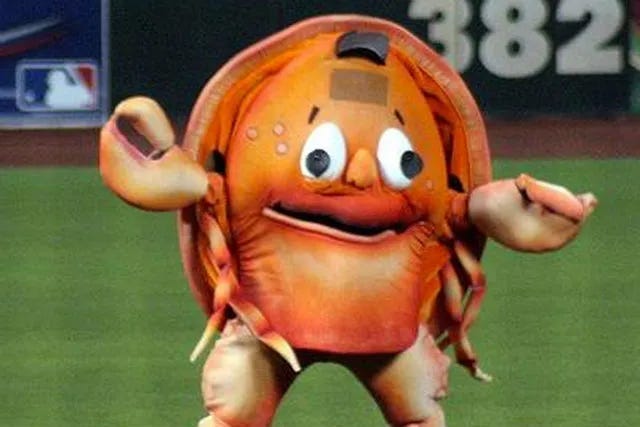
For a while now, I have argued for the return of the Giants much maligned 1984 mascot Crazy Crab. The orange monstrosity only graced the field for one season, but I’ve always found him charmingly eccentric. He was also a harbinger of bad baseball. The Giants finished that season dead last in the division, with a record of 66-96. We an only hope for such a record this season. If Crazy Crab was the mascot for Giants misery, then his time to shine is now more than ever.
Until next time,
M